


Iridology
What is Iridology - Iridology Resources - Iridology Services - Reading the Iris - Iridology Constitutions - Iridology Brain Zones - The Eyes Do Change - How to Take Eye Photos
The Eyes Do Change
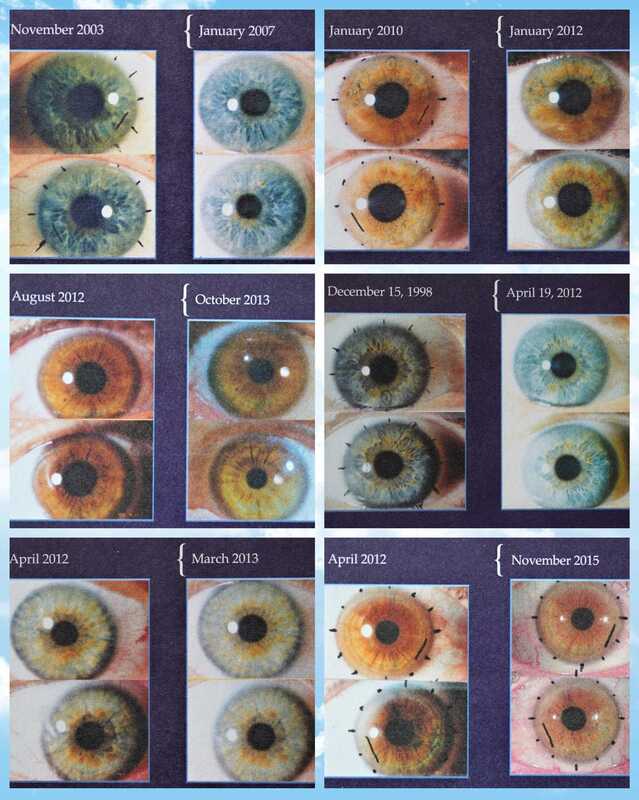
Changes in the Iris manifest after dedicated detox and healing protocol. A Fruitarian lifestyle; fresh fruit and leafy greens, veggie fruits like cucumbers, sweet peppers, tomatoes; sprouts, and periods of mono fruit fasting, juice fasting, even short periods of water fasting will often eventually result in changes in eye color due to lymphatic congestion, sulfur, and toxic encumbrance being cleared from the body and thus reflected in the eyes. The common shifts occur in true blue eyes that appear hazel, green, even partially brown. Because they are blue underneath the 'rubbish' that is the color they return to. True brown eyes, however, those with a velvet texture and deep brown color will change less so, and will not turn blue. Rather, a true brown iris will lighten in color, becoming clearer, and often a lighter brown. Common changes seen in both eye colors are a fading of drug deposits, or pigmentation spots, a filling in of lacunas, and a fading of nerve rings.
The Eyes Do Change FAQ
Do the eyes really change?
Yes. In this framework, the iris can reflect changes in clarity, tone, and visible markings over time, especially with consistent detox and rebuilding work. Commonly discussed shifts include changes in overall brightness, fading of pigment spots, softening of nerve rings, and changes in the appearance of lacunae.
What kinds of changes are most common?
Commonly discussed changes include green or hazel eyes shifting toward clearer blue over time, brown eyes becoming clearer and often lighter brown, fading of pigment spots sometimes called “drug deposits,” softening of nerve rings, and lacunae appearing less pronounced over time.
Why do green or hazel eyes sometimes shift toward blue over time?
Green and hazel eyes are often described as having a blue base with an overlay that affects how the color presents. As the iris becomes clearer over time, that overlay can appear lighter, which lets more of the underlying blue show through. The shift is usually gradual and shows up most clearly when photos are taken under consistent lighting.
Will brown eyes turn blue?
True brown eyes are not described as turning blue. The more common shift is that a brown iris can lighten and become clearer over time, often appearing as a lighter brown with more transparency and clarity.
What is “clarity” in an iris photo, and why does it matter?
Clarity means the iris looks more clean and readable: less murky tone, fewer dense overlays, and more visible fiber detail. Even subtle improvements in clarity can change how an eye reads in photos and in natural light.
What does it mean when pigment spots or “drug deposits” fade?
In this model, pigment spots are one of the visible features people track over time. In photo comparisons, fading looks like darker spots or settled areas lightening compared to earlier images.
What are nerve rings, and what does it mean when they soften?
Nerve rings are circular furrows or tension rings often discussed as nervous system tension patterns in the iris. When they soften, it’s typically described as a reduction in those tension signatures over time.
Can lacunae really “fill in”?
This model describes lacunae as a structural feature that can appear less open or less pronounced as the terrain rebuilds. In photo tracking, the change usually shows up as a lacuna looking smaller, softer-edged, or less dramatic compared to older images.
How long does it take to see changes?
It varies. The general theme is consistency over time: steady lifestyle simplification and periodic deeper cleansing tend to create the most noticeable shifts.
What’s the best way to track changes accurately?
Use consistent photo conditions: similar lighting, same distance and focus, one eye at a time, and multiple shots so you can choose the sharpest. Compare across months rather than days for the cleanest signal.
Iridology Resources & Recommended
The following texts have become my Iridology bibles: Iridology: The Science and Practice in the Healing Arts, Volumes 1 and 2 by Dr. Bernard Jensen; Iridology, A Complete Guide, by Farida Sharan. Dr. Jensen also published Visions of Health - Understanding Iridology, which is excellent as an introduction to Iridology, as well as Iridology Simplified which is more of a pamphlet size intro to Iridology, also excellent. The most comprehensive of all texts mentioned here, a must have text for the serious student of Iridology, is Jensen's Iridology, volume 2.